Let me set the record straight—I’ve been using em dashes for over 30 years. Long before ChatGPT was a glimmer in a server’s eye. Long before AI-generated content started quietly infiltrating inboxes, blogs, and brand guidelines. So when a client recently told me my work “felt AI-written because of all the em dashes,” I almost dropped my MacBook.
Not because I’m afraid of being mistaken for a bot. But because I’m a human who loves em dashes—deeply, truly, and without shame.
And I’m not alone.
The em dash is not a robot glitch—it’s a writer’s signature
In case you missed it, there’s a recent internet conspiracy theory doing the rounds: that em dashes are a telltale sign of AI writing. This rumour seems to have emerged from a blend of Reddit speculation and OpenAI forum frustration, where users complained they couldn’t get ChatGPT to stop using them.
To which I say: that’s not a sign of AI—it’s a sign AI was trained on good writing.
Human writing.
Writers have been using the em dash for centuries. The Oxford English Dictionary traces the term back to 1836. Authors like Emily Dickinson wielded them liberally—often rebelliously. Modern stylists love them for their rhythm, their pause, their soft pivot. As Clive Thompson wrote, “Writers worry they overuse it. They shouldn’t—it’s awesome.”
Check it out: For a fascinating delve into Dickinson’s dashes, read this. (Fellow grammar nazis will notice that , yes, the author erroneously used an en dash instead of an em dash in the first paragraph).
So what is an em dash?
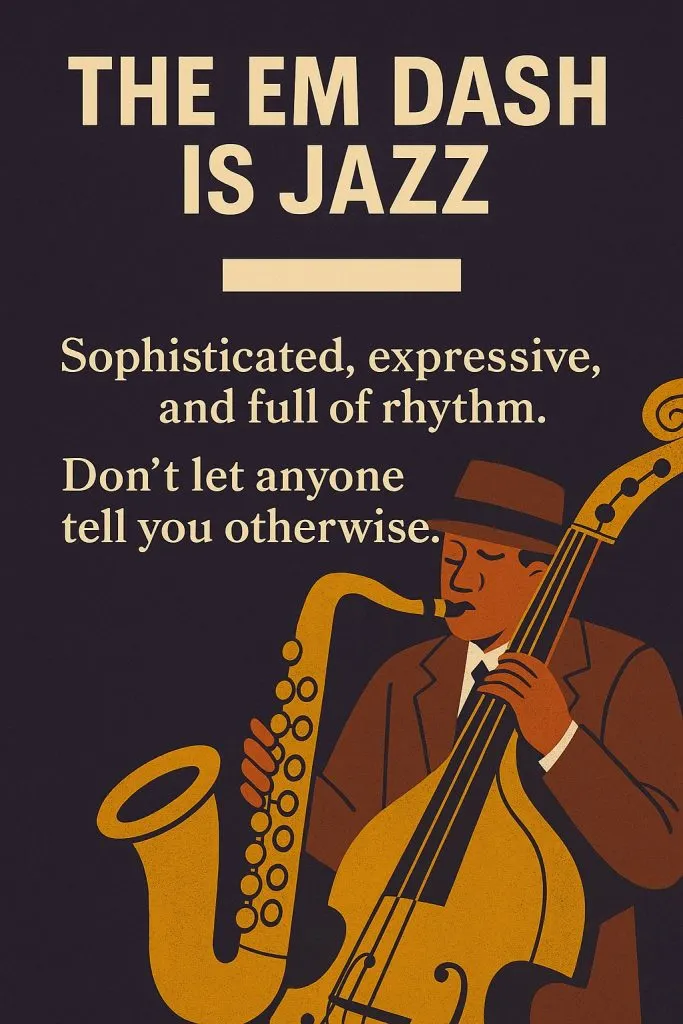
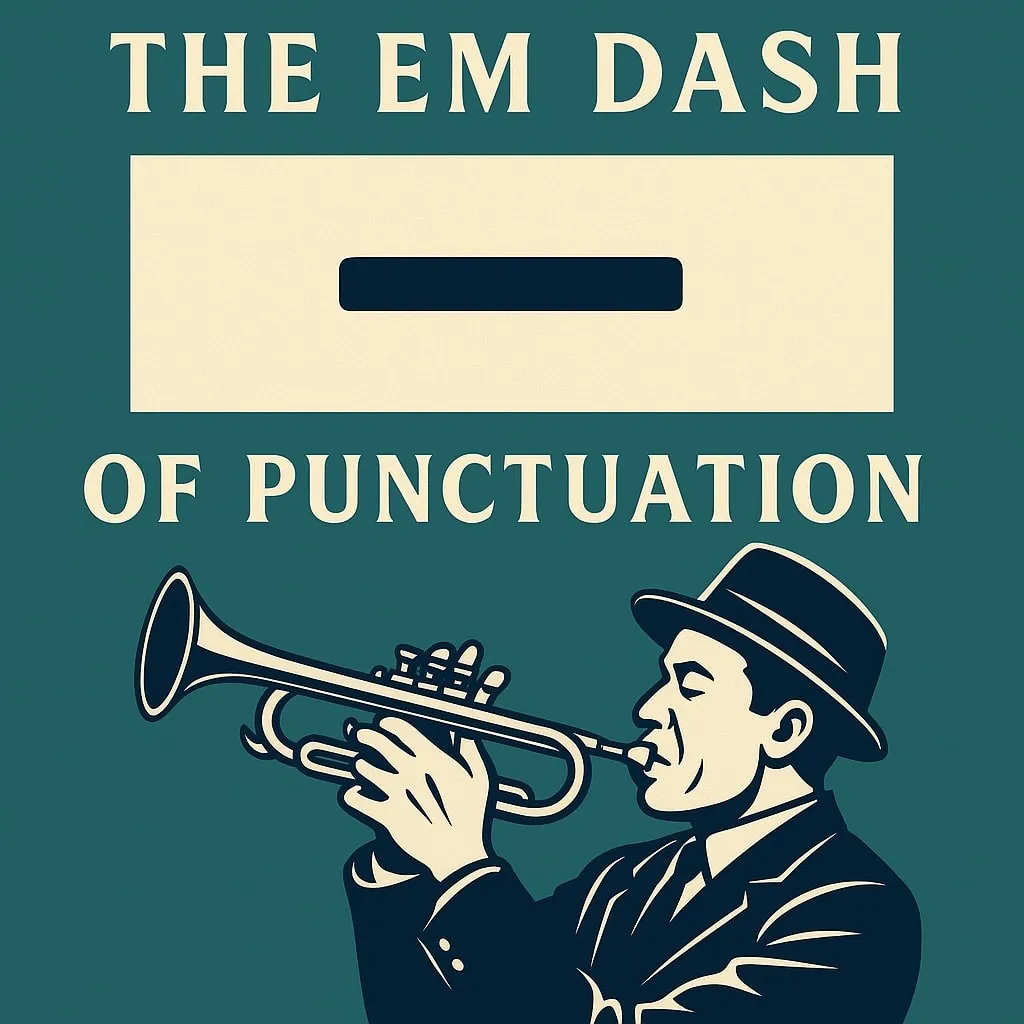
For the uninitiated, an em dash (—) is a long dash used to create emphasis, indicate interruptions, or substitute for commas, colons, or parentheses. It’s the jazz musician of punctuation—improvisational, expressive, a little unexpected. It lets a sentence breathe—or break. It shifts the tone in a heartbeat.
It’s not lazy. It’s not robotic. It’s not a bug.
It’s style.
And like any stylistic device, it can be overdone—sure. Five em dashes in one paragraph screams shonky car dealership copy. But used with purpose and restraint? It’s elegance in a single keystroke.
Why the sudden suspicion?
Lately, we’ve been in a bit of a panic era with authorship. AI can mimic tone, structure, even personality. So we look for clues. Patterns. Tells. But these “tells” are often superficial—and weirdly personal.
Someone on Reddit thinks em dashes are a giveaway because they don’t use them in emails. Someone else assumes nobody uses semicolons anymore. Or that contractions are a bot default. Or that a clear sign of AI writing is liberal use of the oxford comma (or not using it all). It’s become pseudoscience. Confirmation bias. As Mignon Fogarty (aka Grammar Girl) points out, even so-called AI tells like five-dollar words are just human habits fed back to us via machines.
So no—em dashes don’t make your writing sound like a chatbot.
They make it sound like someone who knows how to shape a sentence.
Em dashes in the wild
Want proof that the em dash is human? Just ask the writers.
“The em dash is one of the most versatile punctuation marks in the English language.” —Rachel Harris, 2020
“Writers love em dashes. Once you find out about them, you may fall in love too.” —Kimberly Joki, Grammarly, 2018
“They’re not a period, not a colon—and they’re also not a sign of AI.” —Kate Lindsay, 2025
And let’s not forget: the em dash is harder to type than a regular hyphen. You have to want it. Most people don’t know the shortcut. AI uses them because it was trained on a million thoughtful writers who made the effort.
Good writing isn't about punctuation—it’s about intention
Accusing someone of writing like a bot because they used a specific mark—one that predates AI by centuries—isn’t just inaccurate. It’s lazy criticism.
What matters is how a sentence lands. Whether it reads like a person thought it. Whether the voice carries.
If an em dash helps you hit the right note—great.
If you prefer commas or colons—go wild.
Just don’t pretend your keyboard shortcuts are some universal standard for humanity.
Long live the em dash
I’ll say it again for the people in the back: em dashes are not a sign of AI.
They’re a sign of style. Of breath. Of nuance.
They’ve been used by poets, journalists, copywriters, novelists—and yes, even marketers—for generations.
So let’s retire the hot takes and stop policing each other’s punctuation. Writing is hard enough without trying to out-human one another over a horizontal line.
If you need me, I’ll be over here—using em dashes exactly the way I always have.
With love—and rhythm.
—FVR
For the em dash illiterate and naysayers, here's my hot take on how to use them
An em dash is a versatile punctuation mark that can replace commas, parentheses, and colons. This guide will show you how to use em dashes effectively to make your writing clearer and more engaging.
Key takeaways
An em dash is a versatile punctuation mark that can replace commas, parentheses, colons, and semicolons, improving readability and emphasis in writing.
The em dash is visually distinct, equal in length to the letter ‘M’, and is crucial for creating strong interruptions or highlighting additional information.
Effective use of em dashes involves limiting their occurrence to no more than two per sentence to maintain clarity and impact.
What is an em dash again?

An em dash is a visually striking and functionally versatile punctuation mark. It’s the longest of the three common dash types—longer than a hyphen and an en dash—and it can replace commas, parentheses, colons, and semicolons to create a more pronounced break in a sentence.
Its width matches the height of the font, making it a significant visual element in your writing. When used correctly, em dashes can add dramatic pauses, emphasise additional information, and improve readability by breaking up longer sentences.
Unlike en dashes, which are primarily used to indicate ranges, em dashes can introduce lists, explanatory phrases, and even replace other punctuation marks to enhance the flow and clarity of your writing. With their distinct appearance and multiple uses, em dashes are invaluable tools for any writer.
Yes, that means all those people using en dashes to link ideas in their writing are using them wrong.
Why is it called an em dash?
The em dash gets its name from its length, which is roughly equivalent to the same width of a capital letter M in the typeface being used.
This typographical tradition helps to differentiate the em dash from other punctuation marks like the en dash and hyphen. While the en dash is about half the width of the em dash, the em dash stands out because of its length and distinct usage rules.
Em dashes vs. en dashes

Understanding the difference between em dashes and en dashes is crucial for using them effectively. The em dash is the widest of the three. The en dash is narrower than the em dash, while the hyphen is the narrowest. Em dashes are primarily used to separate extra information or mark a break in a sentence, providing a strong interruption that can replace commas, parentheses, or colons.
En dashes are used to mark ranges, such as dates or numbers, and can also separate clarifications, interruptions, or short lists. The Chicago Manual of Style, for example, limits the use of en dashes to marking ranges and prefers hyphens over en dashes for other cases.
Writers employ em dashes to emphasise or clarify additional information, making them more versatile and dramatic than en dashes. Recognising these differences allows writers to select the appropriate punctuation mark, such as a spaced en dash, to enhance their writing.
Common uses for em dashes

Em dashes are incredibly versatile and can:
Replace commas, parentheses, colons, and semicolons to highlight additional information.
Be used to create emphasis or clarity.
Be especially useful when introducing lists or explanatory phrases—multiple em dashes can enhance this effect.
Em dashes can also replace colons when the following example elaborates on the previous clause — spaced em dash.
Replacing commas
Em dashes can create a stronger emphasis in sentences compared to commas, making them more attention-grabbing. They are especially useful for setting off additional information or asides, enhancing readability and making the sentence more emphatic.
Using em dashes instead of commas can clarify sentences that contain appositives with internal commas, improving overall understanding. For example, in a sentence with multiple commas, replacing a pair of commas with em dashes can make the sentence clearer and easier to read.
Replacing parentheses
Em dashes can effectively replace parentheses to emphasise parenthetical information. This is useful in informal writing, where interruptions or commentary need to be highlighted. For example, “The meeting—scheduled for 3 PM—was postponed” uses em dashes to emphasize the schedule without breaking the flow of the sentence.
When you use dashes instead of parentheses, you should omit the surrounding punctuation to maintain clarity. Some publishers, like the Oxford University Press and Cambridge University Press, prefer en dashes instead of em dashes for parenthetical expressions.
Replacing colons
Use em dashes instead of colons to introduce additional information at the end of a sentence. They emphasise the conclusion of a sentence more dramatically than colons do. For instance, “She had one goal—win the championship” uses an em dash to create a stronger emphasis on the goal.
Em dashes enable the introduction of additional information in a more conversational and less formal manner than colons. This can make your writing more engaging and dynamic, especially when you write with words, nouns, and form.
Replacing semicolons
Em dashes can connect independent clauses, providing a dramatic pause and stylistic flair that semicolons lack. This dramatic effect enhances the emotional impact of the writing, making it so that the sentence makes sense and is more engaging, especially when considering the use of a comma line break.
Using em dashes to highlight lists that follow an independent clause enhances focus and clarity. For example, “The team was ready—excited, nervous, and determined” uses an em dash to emphasise the list of emotions.
Formatting rules for em dashes

Most grammar resources recommend not adding spaces before or after unspaced em dash dashes. Style guides also support this advice. American writing typically format em dashes as closed, without spaces, ensuring the text remains grammatically correct. This creates a clean and professional appearance in your text.
Some newspapers and various style guides recommend using a single space before em dashes. They also suggest using a single space after them. If you don’t use a specific styles guide, it’s important to remain consistent in your spacing formatting.
Typing em dashes on different devices
Typing em dashes can vary depending on the device you are using. On Windows, users can create an em dash by using the character map tool to copy and paste, or by typing two hyphens, which Microsoft Word will automatically transform into an em dash.
Most word processors also convert a pair of hyphens into an em dash automatically, as is usual.
On a Mac
On a Mac, you can type the em dash using the shortcut Option + Shift + Hyphen. This convenient keyboard shortcut makes it easy to insert em dashes while writing, avoiding any mistake. A single dash can also be useful in certain contexts.
In applications like Pages, you can also insert an em dash via the special characters menu. This menu provides a variety of symbols and is useful for finding and inserting the em dash manually.
On Windows
On Windows, you can type an em dash using various methods such as Alt codes, text expansion apps, and copying from other sources. To type an em dash using Alt codes, hold down the Alt key and type 0151 on the numeric keypad.
Special cases for using em dashes
In creative writing, em dashes can show sudden shifts in thought or interruptions. For example, an em dash can signal the interruption of a character’s dialogue, showing another character is speaking or an external action occurs. Including an em dash at the end of a dialogue line indicates the character hasn’t finished speaking.
When a character’s dialogue is followed by an action, you can punctuate the dialogue with an em dash to show the interruption while still maintaining the flow. This punctuation mark can also show a sudden change in thought within a sentence.
Using an em dash to interrupt a character’s speech can convey hesitation, adding depth to the dialogue. When additional information contains its own commas, using em dashes can improve clarity.
To sum it all up, em dashes are powerful grammar tools that can enhance your writing by providing clarity, emphasis, and dramatic flair. By understanding what they are, why they’re named em dashes, and how they differ from en dashes, you can learn to use them—and to love them.
Remember to follow formatting rules and use them sparingly to maintain their impact. Embrace the em dash, and watch your writing come to life.
Frequently Asked Questions
What is an em dash?
An em dash is a punctuation mark that serves as a versatile substitute for commas, parentheses, colons, and semicolons, offering a more pronounced break in a sentence. Its length is the longest among the three dash types, enhancing clarity and emphasis.
Why is it called an em dash?
The em dash is called so because its length corresponds to the width of a capital letter M.
How does an em dash differ from an en dash?
An em dash is used to separate additional information or show a break in thought, whereas you typically use an en dash to denote ranges such as dates or scores.
Can I use an em dash instead of a colon?
Yes, please! Just like a colon, you can use it to introduce additional information, often adding a dramatic emphasis to the sentence.
What are some tips for using em dashes effectively?
To use em dashes effectively, limit their occurrence to two per sentence, ensure consistent formatting, and enhance clarity and emphasis. You’ll refine your writing style and ensure it has maximum impact on the reader.